Anti-Armor Line
Minefields, anti-tank positions, and supporting infantry teams.
EXPLOSIVESGUNS
- PPSh-41
☭ Soviet Union • 1941
Armor-centric systems associated with one of history’s largest tank battles.
Battle Map Context
Layered defense and armored counterstroke defined one of history’s largest tank engagements.
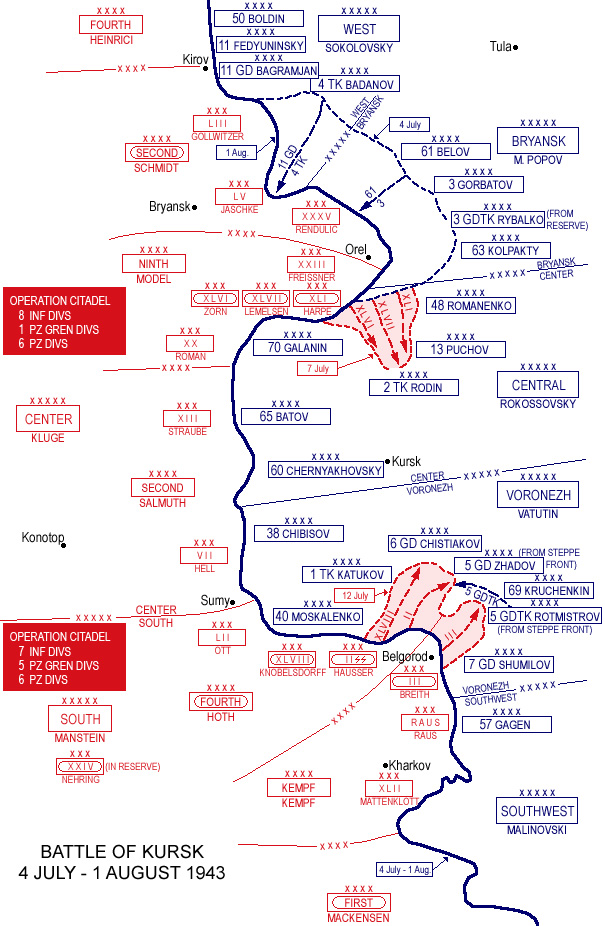
OPEN INTERACTIVE MAP
Map source: Battle of Kursk (map) (Wikimedia Commons)
Anti-Armor Line
Minefields, anti-tank positions, and supporting infantry teams.
☭ Soviet Union • 1941
Armored Counterattack
Mass armor formations contesting operational depth.
Close Air Strike
Air systems delivering interdiction and tactical disruption.
☭ Soviet Union • 1941
Germany • TANKS
Tiger I
The Tiger I was one of the most feared tanks of WW2. Its combination of the legendary 88mm gun and thick armor made it a formidable opponent that could destroy Allied tanks at ranges where they could not effectively fight back.
Soviet Union • TANKS
T-34
The T-34 is widely regarded as the most important tank of WW2 and one of the most influential tank designs in history. Its combination of firepower, protection, and mobility shocked the Germans when first encountered in 1941.
Soviet Union • GUNS
PPSh-41
High-rate Soviet submachine gun produced in very large wartime numbers.
Germany • TANKS
Panther
German medium tank developed after encountering the T-34 on the Eastern Front.
Soviet Union • PLANES
Ilyushin Il-2 Sturmovik
Soviet armored ground-attack aircraft produced in exceptionally large numbers.